
Comprehending Its Constituency and Characteristics
First of all, Wool has long been a beloved fabric because of its warmth, toughness, and adaptability. But beneath its smooth, opulent surface is a sophisticated microstructure that adds to its exceptional qualities. We’ll go into the details of wool fiber in this blog post, examining its makeup and distinctive qualities.
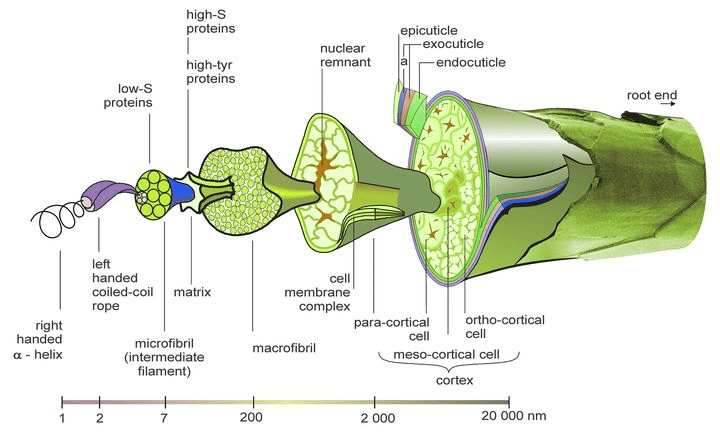
Knowing the Microstructure: The main component of wool fibers is keratin, a protein renowned for forming crystalline copolymers that resemble nylon. The disulphide bonds found in cysteine amino acids allow these proteins to crosslink, enhancing the toughness and strength of the fiber. Researchers have distinguished between two different structures found in wool: alpha- and beta-keratin, using X-ray diffraction.
Wool fiber components include:
1. Cuticle:
The outermost layer covering the wool fiber is called the epicuticle.
– Exo Cuticle: The exocuticle is made up of overlapping epithelial cells.
– Endocuticle: Intermediary layer that connects the cortex’s epithelial cells.
2. Cortex:
Around 90% of the fiber is made up of internal cells that make up the cortex.
There are two primary subtypes of cortical cells: ortho-cortical and para-cortical, which differ in their molecular makeup.
As a result of these cells’ differential expansion upon collecting moisture, fibers display crimp, offering durability and insulation.
3. Cell Cortical:
Acts as a wall’s mortar, enclosing and binding cortical cells.
Have a waxy lipids and proteins that aid in the absorption of dye.
Here, exposure to chemicals or abrasion can cause weak intermolecular connections to break down.
4. Large-scale fibrilla:
Long filaments made up of bundles of smaller microfibrils within cortical cells.
High levels of sulfur proteins in the matrix area help wool retain color and be absorbent.
Accountable for the anti-static and fire-resistant qualities of wool.
Micro-fibrils, which are embedded in the matrix, give the fiber its strength and flexibility.
Have a twisted molecular chain pairs that improve the structural integrity of wool.
Applications and Implications:
Comprehending the intricate structure of wool fiber illuminates its exceptional attributes and adaptability. Wool’s special makeup makes it resilient, fire resistant, moisture-absorbing, and dye-resistant. Applications ranging from upholstery and insulation to fashion and textiles are informed by this knowledge. Wool’s performance and sustainability are further improved by technological and processing developments, which guarantees its continued relevance in today’s environmentally sensitive society.
In conclusion, wool fiber’s microstructure, which combines complex chemical configurations with useful functionality, is a monument to nature’s inventiveness. Each part, from the outer cuticle to the interior matrix, is essential in determining the qualities and uses of wool. We get a greater understanding of this classic fabric and its continuing appeal across a range of businesses as we continue to solve the riddles of wool fiber.
Keywords: Cuticle, Cortex, Matrix, Macro-fibril, Micro-fibril, Sustainability, Microstructure, Wool fiber, and Keratin proteins.